
HOW WE WORK
The Financial Architecture Process
A Structured Approach to Financial Clarity
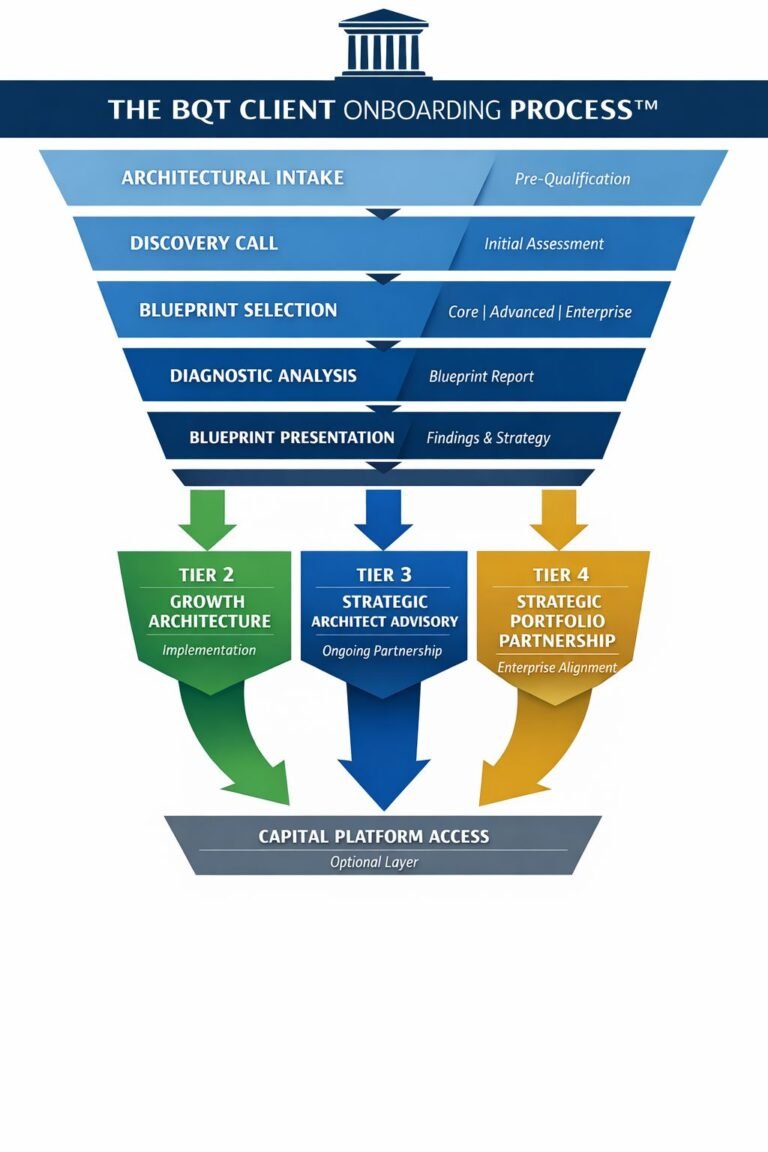
Most financial advice begins with products or transactions.
Our approach begins with architecture.
Before investment decisions are made, before tax strategies are implemented, and before capital is deployed, we focus on designing the structure that guides those decisions.
The Financial Architecture Process provides a disciplined framework for understanding your financial landscape and aligning the strategies that support it.
This process allows us to move beyond isolated advice and toward coordinated strategy.
Discovery
Understanding the Landscape
Every relationship begins with a discovery conversation.
This initial discussion helps us understand your current financial landscape, professional responsibilities, and long-term priorities.
The purpose of discovery is not to deliver advice immediately.
Instead, it helps us determine whether Financial Architecture is appropriate for your situation and how we might structure the next steps.
During this stage we discuss:
- Your professional and financial goals
- Current financial structures and relationships
- Areas of complexity or uncertainty
- Key priorities and concerns
- Potential opportunities for alignment
Discovery is designed to bring clarity to the starting point.
The Financial Architecture Blueprint
Designing the Structure
Once discovery confirms that our approach is appropriate, the next step is the Financial Architecture Blueprint.
The Blueprint is a structured diagnostic process designed to evaluate how the major components of your financial life interact.
Rather than focusing on isolated decisions, the Blueprint evaluates the broader system.
Areas reviewed may include:
- Financial structure and entity alignment
- Capital allocation strategy
- Tax efficiency considerations
- Risk and protection alignment
- Liquidity and cash-flow planning
- Investment diversification
- Long-term succession planning
The result is a comprehensive view of how your current structure supports — or limits — your long-term objectives.
This stage allows us to identify opportunities for alignment before implementation begins.
Implementation
Coordinating the Strategy
Once the architecture has been designed, implementation begins.
This stage focuses on coordinating the professionals, strategies, and decisions necessary to align the system.
Implementation may involve:
- Portfolio positioning adjustments
- Tax coordination strategies
- Risk and protection alignment
- Liquidity planning adjustments
- Strategic financial structuring
- Collaboration with other professional advisors
The goal is not simply to make individual changes.
It is to ensure those changes work together within the broader architecture.
Strategic Oversight
Guiding Financial Decisions Over Time
Financial structures are not static.
Life evolves.
Businesses grow.
Markets shift.
Opportunities emerge.
Strategic oversight ensures that your financial architecture evolves alongside these changes.
Clients engaged in ongoing advisory relationships receive structured guidance designed to help them navigate complex decisions as they arise.
Strategic oversight may include:
- Portfolio review and capital allocation adjustments
- Tax strategy coordination
- Risk management reviews
- Planning for business transitions or liquidity events
- Evaluating new opportunities for growth and diversification
This ongoing coordination helps maintain alignment as circumstances change.
Long-Term Stewardship
Architecture That Supports Generations
Financial Architecture is not only about current decisions.
It is also about preparing for the future.
Over time, many clients begin to focus on long-term stewardship:
- Preparing for retirement or transition
- Structuring wealth for the next generation
- Supporting philanthropic priorities
- Protecting the legacy of their work
Our role is to help ensure that the structures supporting your financial life remain aligned with these long-term objectives.
Through disciplined architecture, decisions made today can support opportunities for decades to come.
THE CLIENT JOURNEY
From Discovery to Long-Term Strategy
The Financial Architecture Process follows a structured path.
Discovery → Blueprint → Implementation → Strategic Oversight → Stewardship
This sequence ensures that every step is intentional and coordinated.
Rather than reacting to isolated financial decisions, the process creates a framework that guides them.
Begin the Architecture
If your financial life has grown complex — or if you simply want greater clarity and coordination — the first step is a discovery consultation.
During this conversation we will:
- Learn about your financial landscape
- Identify areas of opportunity or misalignment
- Discuss how Financial Architecture may apply to your situation
From there, we determine the appropriate next step.
Structure creates clarity.
Clarity supports better decisions.
And better decisions create lasting stewardship.